You can contact us at +27 76 985 0956 | info@chapter96bookz.co.za

Contact Us
Our Shop
Contact us for all your questions and opinions


• ISBN 978-1913677169
•Pages 40
• Binding Softcover
“Imagine me In the future Insha’Allah, when I’m as big as big can be! Doing things I truly love with my special qualities.” Find out what some boys and girls would like to do when they grow up as they reflect on their skills, passions and character traits. At the end of the book, children are encouraged to think about their own strengths and uniqueness, and imagine what they would like to do in the future. This colourful, imaginative rhyming book can help children to strengthen their self-esteem, learn tools and tips on how to cope with challenges and build their reliance upon Allah.

•ISBN: 978-1-952306-48-8
•Pages: 146
•Binding: Paperback
Concerning Divine Wisdom in the Creation of Man is a selected translation and commentary of Imam al-Ghazali's treatise on the human anatomy and physiology. In it, al-Ghazali masterfully provides the seeker of religious knowledge a window into Allah’s creativity through the Islamic study of anatomy. The study of anatomy for the Muslim serves as a potential means to fulfill two distinct goals: To increase one’s attachment to the Creator through a deeper appreciation of the details of His creation Or to become a professional with knowledge of diseases and cures The broad audience of medical students, physicians, healthcare professionals, as well as non-medical seekers of religious knowledge will appreciate the details of human anatomy described by Imam al-Ghazali through an Islamic lens. Readers will also recognize that this discussion, though accurate from the perspective of modern medicine, reflects a distinctly different paradigm from that of modern anatomy and physiology. Imam al-Ghazali asserts that there is a spiritual component to the human being, and that every detail of human anatomy is representative of Allah's qudra, His power, and His wisdom. In this text, al-Ghazali describes these spiritual purposes alongside the physical anatomy, with the same level of clarity and precision. This edition includes Dr. Kamran Riaz's meticulous English translation side-by-side with al-Ghazali's original Arabic text. The translation is followed by over 150 endnotes from Dr. Riaz and Shaykh Mohammed Amin Kholwadia.

•ISBN: 978-1-952306-37-2.
•Pages: 80
•Binding: Leather PU
Instantly Recognized Anywhere In The World By Its Epithet, The Burdah Is A Timeless Tribute To The Prophet Muhammad ﷺ, Which Although Penned In The Twelfth Century, Still Resonates Deeply Due To The Affinity Generated By The Author’s Spiritual Journey. Designed by Naveed Hameed; Translated by Shaykh Adnaan Raja The poem begins with Imam al-Busiri’s struggle against his ego, as he showcases the hallmarks of true Muhammadan love. Through praising the Prophet ﷺ , narrating events and miracles from the Prophet’s ﷺ life, as well as lauding the majesty of the Holy Qur’an, the ode culminates with Imam al-Busiri’s miraculous rehabilitation, as he petitions the Prophet ﷺ. All of which takes place with the Imam turning back to Allah ﷻ during reconciliation with his faith, and a noetic realization about the reality of the world.

Imam Dawud Walid – Blackness and Islam
•ISBN: 9,781,909,853,195
•Pages: 150
•Binding: Paperback
Muslims speak of Islam in egalitarian terms: the religion of peace, the religion that seeks to elevate man over his base desires, the religion that does not discriminate based on race and ethnicity. Despite the egalitarian spirit of Islam, the lived reality of many Muslims is very different, and this is most apparent when we observe how Muslims deal with race and ethnicity. Muslims who are Black in the West in particular, have found that while Islam may not discriminate based on race, many Muslims do. To make matters worse, some of those Muslims will delve in to the Islamic tradition to justify their biases and bigotries, seeing no contradiction between their racism and the Islamic ideals. This work seeks to clarify and debunk some traditions which support their racist positions, and presents biographies of early Muslims who were Black. The biographies of these great Muslim personalities shows us how Blackness was a normal part of life for early Muslims, in sharp contradistinction to modern prejudices against Black folks found in some Muslim communities. “Imam Dawud Walid’s life’s work – in his previous publications, in the present volume and over the decade that I have known him – commends him as a soldier against satanic racism and especially its most perfect historical expression: white supremacy. This volume, by framing a religious response to what must be understood as a satanic spiritual attack, should be widely read and taught.”

•ISBN: 978-1-952306-28-0
•Pages: 100
•Binding: Paperback
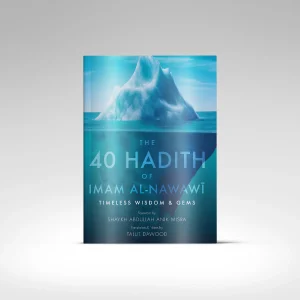
Known in Arabic simply as the Arba'in, "The Forty," this is without question the most widely-known and widely-read small compilation of Prophetic hadith. Across the world, from the east to the west, Imam al-Nawawi's collection is often the first, and sometimes the only Hadith text many Muslims study in their lives. Each hadith in this collection and serves as a foundational proof text in at least one area of the Islamic sciences. Being of such importance, these Hadith are also incredibly dense in meaning; one of Allah's gifts to His Prophet ﷺ was the ability to convey volumes in only a few words, and the Hadith of the Arba'in are among the best examples of this

Imām Ṭaḥāwī’s Sharḥ Maʿānī al-Āthār is a timeless and universal masterpiece from amongst the greatest compilations of Islamic literature. Consisting of a wide array of vast and unique Prophetic traditions, it is a detailed and indispensable resource in jurisprudential matters. As a key text within the Ḥanafī School of Law, it dispels the oft-assumed notion of the School being solely one of reason by substantiating many legal verdicts of the great luminary Imām Abū Ḥanīfah (Rh.) with not only the proposition of rationale but also with highly authentic supporting evidences. The key distinguishing factor of this work from others is its unmatchable style of composition and argumentation in deducing legal rulings and deeply analysing therein; all the while assisting its readers by explaining in a coherent, cogent, and comprehensive manner. As an outstanding treatise of Imām Ṭaḥāwi (Rh.) it embodies a lifetime of discerning sacred knowledge and formulating independent decisions based on such; pro- viding a glimpse into the depths and magnitudes of his knowledge. This book has been translated into English in the hope of making the text more accessible and enabling an appreciation for it amongst the masses.


In The Prophet’s Garden (A selection of Hadith for the Young) – Fatima M.D’oyen & Abdelkader Chachi

A question commonly posed in different circles is: if we all refer to the same sacred texts of the Quran and Sunnah for guidance, why are there so many differences between the schools of Islamic law (madhahib)? In other words, why did the great jurists (fuqaha) of Islam such as the four main Imams and their students differ in their opinions and rulings? This work attempts to answer this very question, focusing on one aspect, namely: how different understandings of the hadith literature influenced and shaped these differences in opinion. In addition, the author responds to some of the misgivings and objections which some people levy against these distinguished luminaries of Islam.This valuable work is a must-read for students of hadith and fiqh, as well as anyone wishing to gain a better understanding of the differences that occur between the various schools of Islamic law. It will alert the reader to the expertise of the jurist Imams and the effort they exerted in deriving rulings from the Quran and Sunnah. It will also create in him a state of serenity and trust towards the Imams and their schools of law, which are followed by the vast majority of the Muslim Ummah.


• ISBN 978-0946621477
•Pages 261
• Binding Softcover
A wide-ranging study of the Muslim religion which aims to explore what it means to be a Muslim, a member of the community which embraces a quarter of the world's population and to describe the forces which have shaped the hearts and minds of Islamic people.