You can contact us at +27 76 985 0956 | info@chapter96bookz.co.za

Contact Us
Our Shop
Contact us for all your questions and opinions


• Publisher Ta-Ha Publishers LTD
• ISBN 978-1842001349
•Pages 259
• Binding Softcover
Al-Fawz al-Kab r f U l at-Tafs r The Great Victory, on Qur nic Hermeneutics is a manual of the principles and subtleties of Qur nic tafs r. In it the author outlines the five fundamental sciences that the Qur n contains: the science of judgements (a k m), reminding others of the Favours of Allah, the Days of Allah and the Life after Death, and giving particular attention to the science of polemics. He also reviews the other sciences of tafs r such as the circumstances of revelation (asb b an-nuz l), abrogating and abrogated y t (an-n sikh wa l-mans kh) and the unusual words and phrases of the Qur n (ghar ib al-Qur n), before concluding the book by looking at the extraordinary and miraculous aspects of the Noble Book, and a final chapter on the meanings of the letters of the Arabic alphabet.
• ISBN 978-1842001349
•Pages 259
• Binding Softcover
Al-Fawz al-Kab r f U l at-Tafs r The Great Victory, on Qur nic Hermeneutics is a manual of the principles and subtleties of Qur nic tafs r. In it the author outlines the five fundamental sciences that the Qur n contains: the science of judgements (a k m), reminding others of the Favours of Allah, the Days of Allah and the Life after Death, and giving particular attention to the science of polemics. He also reviews the other sciences of tafs r such as the circumstances of revelation (asb b an-nuz l), abrogating and abrogated y t (an-n sikh wa l-mans kh) and the unusual words and phrases of the Qur n (ghar ib al-Qur n), before concluding the book by looking at the extraordinary and miraculous aspects of the Noble Book, and a final chapter on the meanings of the letters of the Arabic alphabet.

"Risalah al Mufeedah or commonly referred to as Al Mufeedah. Written by the Qadi of the Muslim Judicial Council and one of Cape Towns senior scholars Sheikh Muhammad Armien Fakier:
The book includes the following topics:
- Arkaanul-Islaam, Arkaanul-Eemaan, the Ih’saan and the Kalimah of Shahaadah
Allah and his attributes, the angels, the revealed books, the prophets, the last day, the divine decree and a short biography of our prophet Muhammad (PBUH)
- The meaning of Mukal’laf, cleanliness, najaasah, the niy’yah, ha’dith, the division of water and is’tinjaa
Abolution, wiping over the Khuf’s, Ghus’l, Tayam’mum, A’thaan, Iqaamah,
- Salaah, Sujoodus-Sah’wi, the Sujood of Tilaawah and the Salaah of Jamaa’ah
The Jumu’ah prayer, the two Eids, the Salaah of Is’tikhaarah, the Salaah of Tas’beeh, the Salaatul-Haajah, the Salaah of Tahaj’jud, the praying for rain, and the Salaah of Kusoof and Khusoof (eclipse of the sun and the moon)
- The Salaatul-Janaazah, Aayatul-Kur’si and Sayi’yidul-Is’tigh’faar. Zakaah, Fasting, the Salaah of Taraweeh, Sodaqatul Fit’r, the I’tikaaf, the Hajj and Umrah
- The Khit’bah, the marriage, the Tas’miyah (naming a child), the Aqeeqah, the Qurbaan, and prayers for different occasions.
- The Janaazah, how to prepare the Kafan, how to perform Ghus’l, the burial, visiting the grave and graveyard, the Shaheed/Martyr, the Siq’t/miscarriage, the Id’dah(the waiting period for a woman) and the testamin/will of a muslim.
A must have for every Muslim old or new, every household or anyone interested in learning more about Islam."

"This book is ideal for those who wish to read for personal edification as well as those who would like to conduct classes. Every ḥadīth is followed by a detailed explanation of its importance, its vocabulary, followed by its fiqh rulings, along with other insights that can be gleaned from it.
It is hoped that as the reader reads through the text, his understanding and appreciation of the Prophet’s words ﷺ will deepen, and he will also come to see the immense wisdom in Imam an-Nawawī’s choices. If Allah so wills, the reader will emerge with a broader and more thorough understanding of Islam itself.
‘I saw that I should gather forty ḥadīths that are more important than all of them, and they are forty ḥadīths that comprise all of that, each one being an immense foundation of the Religion and the scholars have described it by saying that Islam revolves around it, or it is half of Islam or a third of it, and so forth.’
Imam Abu Zakariya Yahya al-Nawawi
‘We were then determined to write a commentary on The Forty of Imam an-Nawawī, and add the fifty-first commentary to the other commentaries on these blessed ḥadīths, not so that it would be forgotten on old library shelves and become tasty food for insects and dust. Rather, we wanted it to become, with Allah’s permission, printed letters, words, and pages, so that it reaches the Muslim reader in the easiest script, the clearest method and the most beautiful garb.’
About the Authors:
He is the beloved scholar, Prof. Dr Muṣṭafā Dīb al-Bughā al-Maydānī ad-Dimashqī ash-Shāfiʿī, born in the year 1938M/1354AH in the district of Maidan in the city of Damascus, Syria. He specialised in Comparative Fiqh and the methods used in judging evidence according to different madhhabs. Amongst his teachers were Imam Hasan Habanakah al-Maidani and his students Khairu Yasīn al-Maydānī, Hāni al-Mubarak, Ḥusayn Khaṭṭāb, and Muḥammad Kurayyim Rājih while he was in Damascus.
Shaykh Muṣṭafā al-Bughā has authored and commented upon numerous books on numerous areas in fiqh and is well-respected throughout the Muslim world for his deep knowledge and charisma in discussing intricate matters. He has taught and lectured in many different Universities throughout the world, which includes, Qatar, Jordan, Malaysia, and Dagestan.
Shaykh Dr Muḥyī ad-Dīn Dīb Mistū, a professor and renowned author from Damascus Syria. He is regarded as the teacher of scholars and a respected lecturer at the Al-Fatḥ Islamic Institute, which offers undergraduate and postgraduate studies for both male and female students from all over the world.
To date, Shaykh Muḥyī ad-Dīn has either authored or co-authored eighty-two written publications of books and research papers. Most of his books are well known and used in Islamic institutions and universities throughout the world. While the majority are written in Arabic, there are some that are translated into Malay, French and Urdu."
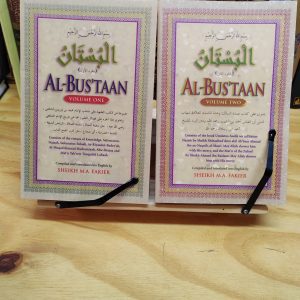
Title: Al-Bustaan
Author: Sh M.A Fakier
ISBN: 9780620260077
Binding: 2 volumes in softcover
Price: R450 for 2 volumes
Al- Bustaan is a masterpiece completed over 20 years ago by the previous Qadi of the Muslim Judicial Council in Cape Town South Africa.
It is a collection of classical mutoon or concise texts cover Fiqh or Islamic Jurisprudence according to the Shafi Madhab. The texts are classical texts studied across the global for hundreds of years and are continued to be used in Madaris in our own community. The reader is taken from the beginner level with texts such as Safinatun Najah, intermediate texts as thew Muqadimmatul Hadramiyyah and advanced texts such as the Umdat us-Salik and Safwat uz-Zubad. This is a must have collection for all students of sacred knowledge and for every home, as a reference and a book that all should aspire to read with a teacher. The Arabic texts are included along with a translation.
Volume 1 contains:
- The virtues of knowledge and its people
- Safinatun Najah
- Safinatus Salah
- Riyaadul Badiyyah
- Muqadimmatul Hadramiyyah
- Matn of Abu Shuja
Volume 1 contains:
- Umdat us-Salik
- Safwatu Zubad

Al-Fiqh Al-Manhaji: A Systematic Manual According to the Madhhab of Imam Ash-Shafi’i, Volume 1, Purification & Prayer
Paperback - 272 pages
By - Shaykh Muṣṭafā al-Khin, Shaykh Muṣṭafā Dīb al-Bughā, & Shaykh ʿAlī ash-Sharbajī
Translated by - Mahdi Lock
Published - May 2023
ISBN - 9789811870897
The best that man preoccupies himself with is knowledge of the lawful and the unlawful regarding rulings, and knowing the valid from the invalid regarding actions; it is the science of fiqh that has taken it upon itself to elucidate that. Many of the early scholars wrote so many books in this field that it is almost impossible to count; including exhaustive works, abridged works, commentaries, and research papers focusing on main issues as well as branch issues. The Islamic library still needs to grow, which is this book’s point of departure; it covers the main fiqh issues along with their evidences from the Noble Book and the Purified Sunnah, and the authors have also added whatever wisdoms can be gleaned from each ruling. The wording is clear and concise and the numerous headings and subheadings make it very easy for the reader to navigate the various topics and issues.

• Publisher The Islamic Texts Society
• ISBN 978-1911141358
•Pages 380
• Binding Softcover
The spiritual life in Islam begins with riyadat al-nafs, the inner warfare against the ego. Distracted and polluted by worldliness, the lower self has a tendency to drag the human creature down into arrogance and vice. This translation of two chapters from The Revival of the Religious Sciences (Ihya' 'Ulum al-Din) details the sophisticated spiritual techniques adopted by classical Islam.
• ISBN 978-1911141358
•Pages 380
• Binding Softcover
The spiritual life in Islam begins with riyadat al-nafs, the inner warfare against the ego. Distracted and polluted by worldliness, the lower self has a tendency to drag the human creature down into arrogance and vice. This translation of two chapters from The Revival of the Religious Sciences (Ihya' 'Ulum al-Din) details the sophisticated spiritual techniques adopted by classical Islam.

Al-Ghazali on Manners Relating to Eating – Abu Hamid al-Ghazali
• Publisher The Islamic Texts Society
• ISBN 978-1911141037
•Pages 106
• Binding Softcover
Al-Ghazali on the Manners Relating to Eating is the eleventh chapter of The Revival of the Religious Sciences which is widely regarded as the greatest work of Muslim spirituality. This volume begins the section dealing with man and society, and the norms of daily life. While concentrating on a daily activity, eating, al-Ghazali presents the importance of aligning every aspect of one’s life with religion and spirituality. Referring extensively to the example of the Prophet and to that of the early Sufis, al-Ghazali illustrates how the simple activity of eating can encourage numerous virtues which are themselves necessary for the remainder of the spiritual life. The sections of Al-Ghazali on the Manners Relating to Eating are divided into what a person must uphold when eating alone, how a person must conduct himself when eating in company and the manners of hospitality. Through these sections, al-Ghazali also discusses lawful and unlawful foods and practices, cleanliness, fasting, general health issues, and the blessings of contentment with little and generosity.
• ISBN 978-1911141037
•Pages 106
• Binding Softcover
Al-Ghazali on the Manners Relating to Eating is the eleventh chapter of The Revival of the Religious Sciences which is widely regarded as the greatest work of Muslim spirituality. This volume begins the section dealing with man and society, and the norms of daily life. While concentrating on a daily activity, eating, al-Ghazali presents the importance of aligning every aspect of one’s life with religion and spirituality. Referring extensively to the example of the Prophet and to that of the early Sufis, al-Ghazali illustrates how the simple activity of eating can encourage numerous virtues which are themselves necessary for the remainder of the spiritual life. The sections of Al-Ghazali on the Manners Relating to Eating are divided into what a person must uphold when eating alone, how a person must conduct himself when eating in company and the manners of hospitality. Through these sections, al-Ghazali also discusses lawful and unlawful foods and practices, cleanliness, fasting, general health issues, and the blessings of contentment with little and generosity.

• Publisher The Islamic Texts Society
• ISBN 978-0946621316
•Pages 216
• Binding Softcover
In this work, here presented in a complete English edition for the first time, the problem of knowing God is confronted in an original and stimulating way. Taking up the Prophet's teaching that 'Ninety-nine Beautiful Names' are truly predicated of God, the author explores the meaning and resonance of each of these divine names, and reveals the functions they perform both in the cosmos and in the soul of the spiritual adept. Although some of the book is rigorously analytical, the author never fails to attract the reader with his profound mystical and ethical insights, which, conveyed in his sincere and straightforward idiom, have made of this book one of the perennial classics of Muslim thought, popular among Muslims to this day.
• ISBN 978-0946621316
•Pages 216
• Binding Softcover
In this work, here presented in a complete English edition for the first time, the problem of knowing God is confronted in an original and stimulating way. Taking up the Prophet's teaching that 'Ninety-nine Beautiful Names' are truly predicated of God, the author explores the meaning and resonance of each of these divine names, and reveals the functions they perform both in the cosmos and in the soul of the spiritual adept. Although some of the book is rigorously analytical, the author never fails to attract the reader with his profound mystical and ethical insights, which, conveyed in his sincere and straightforward idiom, have made of this book one of the perennial classics of Muslim thought, popular among Muslims to this day.

• Publisher The Islamic Texts Society
• ISBN 978-0946621132
•Pages 378
• Binding Softcover
This is the first English translation of the last chapter of Al-Ghazali's Revival of the Religious Sciences (Ihya' 'Ulum al-Din), widely regarded as the greatest work of Muslim spirituality. After expounding his Sufi philosophy of death and showing the importance of the contemplation of human mortality to the mystical way of self-purification, Ghazali takes his readers through the stages of the future life: the vision of the Angels of the Grave, the Resurrection, the Intercession of the Prophet, and finally, the torments of Hell, the delights of Paradise and—for the elect—the beatific vision of God's Countenance.

• Publisher Ta-Ha Publishers LTD
• ISBN 978-1842001615
•Pages 120
• Binding Softcover
Al-Khasa'is as-Sughra has enjoyed popularity among the masses for many centuries. It is the author's own summarised version of the merits that are exclusive to the Last Prophet Muhammad (SAAS). Over four chapters, the author lists the unique particulars of Prophet Muhammad (SAAS) and of His Community (Ummah)-i.e. the Muslims, by which they are uniquely honoured in this world and the next, respectfully comparing some of them to previous Prophets and their Communities. He ends with salutations on the Prophet (SAAS) and a humble prayer.
• ISBN 978-1842001615
•Pages 120
• Binding Softcover
Al-Khasa'is as-Sughra has enjoyed popularity among the masses for many centuries. It is the author's own summarised version of the merits that are exclusive to the Last Prophet Muhammad (SAAS). Over four chapters, the author lists the unique particulars of Prophet Muhammad (SAAS) and of His Community (Ummah)-i.e. the Muslims, by which they are uniquely honoured in this world and the next, respectfully comparing some of them to previous Prophets and their Communities. He ends with salutations on the Prophet (SAAS) and a humble prayer.

Title: Al - Mutoon al-Thahabiyyah - The Golden Text
Authors: Sh Mogamat Armien Fakier and Sh Ebrahim Moos
ISBN:9780639762135
Binding: Softcover
A collection of mutoon or concise texts covering several subjects. The book includes the Arabic and Engish Translation and is a must-have for all students and madaris.
- Aqeeedah or Islamic Belief
- Umm al Barahin
- Aqeedatul Awaam
- Jowhara al- Tawhid
- Manthumah al-Tafsir
- Al Bayquniyyah poem
- Nukbatul Fikr
- 40 Hadith of Imam Nawawi
- Al-Waraqaat
- Safinatun Najah
- Matn of Abu Shuja
- Al-Rahbiyyah
- from Safwatu Zubdab
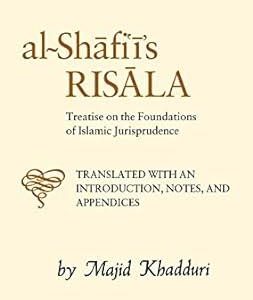
• Publisher The Islamic Texts Society
• ISBN 978-0946621156
•Pages 380
• Binding Hardcover
Written in the second Islamic century by al-Imam al-Shafi'i (d. 204AH/820AD), the founder of one of the four Sunni schools of law, this important work gives the fundamental principles of Islamic jurisprudence and its influence continues to the present day. During the early years of the spread of Islam, the exponents of Islamic legal doctrine were faced with the problems raised by ruling and administering a diverse and rapidly growing empire. In Medina and Kufa, as well as other cities of early Muslim rule, schools of law had to be developed, but it took the genius of Muhammad b. Idris al-Shafi'i, born in the year 150AH/767AD, to establish the principles by which the various legal doctrines could be synthesised into a coherent system. In the Risala, which laid down the basis for such a synthesis, al-Shafi'i established the overriding authority, next only to the Qur'an, of the Sunna or example of the Prophet Muhammad as transmitted in the traditions.
• ISBN 978-0946621156
•Pages 380
• Binding Hardcover
Written in the second Islamic century by al-Imam al-Shafi'i (d. 204AH/820AD), the founder of one of the four Sunni schools of law, this important work gives the fundamental principles of Islamic jurisprudence and its influence continues to the present day. During the early years of the spread of Islam, the exponents of Islamic legal doctrine were faced with the problems raised by ruling and administering a diverse and rapidly growing empire. In Medina and Kufa, as well as other cities of early Muslim rule, schools of law had to be developed, but it took the genius of Muhammad b. Idris al-Shafi'i, born in the year 150AH/767AD, to establish the principles by which the various legal doctrines could be synthesised into a coherent system. In the Risala, which laid down the basis for such a synthesis, al-Shafi'i established the overriding authority, next only to the Qur'an, of the Sunna or example of the Prophet Muhammad as transmitted in the traditions.

Translation & Commentary by Abdul Aziz Suraqah and Mohammed Aslam
The Shama’il al-Muhammadiyya of Imam al-Tirmidhi presents us detailed descriptions of the moral, physical and spiritual qualities of the Prophet Muhammad ﷺ. The perfections that Allah bestowed upon the Prophet Muhammad ﷺ encompass every aspect of his blessed being: his outward physical form, his senses, his internal form and his inner beauty. The Prophet Muhammad ﷺ is the most perfect embodiment of created beauty and form, and he is unsurpassed in his perfections. No one can rival or outstrip him in any laudable quality or trait. He knows Allah as He should be known. He fears Allah as He should be feared. He loves Allah as He should be loved. Understanding the Shama’il is absolutely critical to any proper understanding of Islam, for it details the qualities of the message-bearer, which fundamentally alters how we understand the message he brought.
Praise for the Shama'il
This book is truly amazing. The level of thought and care is inspiring. First of all, the Arabic is based on the best edition recommended by scholars in Egypt. The English translation is masterful. The designs are beautiful and the footnotes add a lot to text. It’s a must have. I very highly recommend this book for anyone who wants to know about Prophet Muhammad (pbuh) and to grow closer to him. – Aisha M.
A beautiful book Masha’Allah. The pages are as aesthetically pleasing as the words. A Must have for any Islamic library. – B. Smith
Nearly 1000 notes
320 pages
Hardback (Leather PU Bound)
Full color print
Language: English with Arabic
High-quality glossy 115gsm paper
Gold gilded edge
Illuminating gold ink on each page

•Publisher: Ashnataar Publications
•ISBN: WIRD
•Pages: 72
•Binding: Softcover
The Wird al-Laṭīf, is a form of Dhikrullah (Remembrance of Allah), is also known as the Graceful and Benevolent Litany. It reflects on many of of the attributes of Allah.
This Wird consists of invocatory sayings of the Prophet (SAW) which the author has holistically weaved between pertinent Quranic verses into a graceful and harmoniour tapestry. Coupled with these, are a number of inspirational lines provided by the author himself. This Wird is called the Wird al-Laṭīf, because it is kinder and lighter of the awrad.
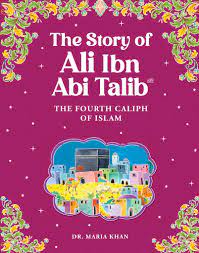
Ali ibn Abi Talib, the cousin and son-in-law of the Prophet Muhammad, was also one of the members of the Prophet’s household. The Prophet took him into his care when he was only 5 years old and gave him an excellent upbringing. And from then onwards, he remained with the Prophet until he married the Prophet’s daughter Fatima after the migration to Madinah. In fact, he was so close to the Prophet that once the Prophet said to him, “You are of me, and I of you.” This closeness, however, entailed great responsibility along with constantly being tested with trying situations.
In the course of time, Ali became well-versed in Islamic knowledge, achieved profundity in religion and lived a life of deep realization and spirituality. The Caliphs Abu Bakr, Umar and Uthman used regularly to consult him in matters of importance. After Uthman’s death, Ali was chosen to be the fourth Caliph of Islam.
Ali loved and obeyed Allah and His Messenger so much that he was given the title of al-Murtada, or the one with whom Allah is pleased.

•Publisher: Plan n Learn
•ISBN: 9780620459600
•Pages: 60
•Binding: Softcover
Alif, Baa, Taa Colouring and Activity Book