You can contact us at +27 76 985 0956 | info@chapter96bookz.co.za

Contact Us
Our Shop
Contact us for all your questions and opinions


In her debut poetry book, the #1 international bestselling author of Secrets of Divine Love, invites you to step into her beautifully composed world of devotional poetry. From Darkness into Light is a profoundly passionate book of poetry about mercy, guidance, timeless wisdom, prayer, self-love, faith, and the soul’s ultimate journey of healing, connection, and unity with the One.
From Darkness into Light was written for those who are longing to experience a journey of spiritual deepening. For those who are looking for hope, for connection, and for a deep relationship with Allah. From Darkness into Light will inspire you to approach the Divine from love. It will show you how to turn your worries into worship and how to walk the path to God with all of your insecurities and doubts. This book is not for the person who is perfect in their relationship with God, but those who are looking to approach God with sincerity and honesty.
From Darkness into Light lovingly reminds you:
God’s plan for you is more glorious than you can ever imagine
You are loved exactly for who you are
God’s mercy encompasses everything including you
The light you seek is already inside of you
From Darkness into Light is perfect for:
Muslim men and women of all ages
Teachers to share with classrooms during poetry focused lessons
Readers inspired by the works of Persian or Islamic poetry from writers such as Rumi, Hafiz, Saadi, Attar, Imam Al-Ghazali, Ibn Arabi, Khalil Gibran, ibn Qayyum, and others.
Ramadan, Eid Celebration, New Years, Hajj, and holiday gifting
Fans of the internationally bestselling From Darkness into Light are saying "masterfully written", "filled with such gems of wisdom", "Very uplifting", and "The words bring comfort to my heart.”

- 4 Volumes
- Translator: Rafiq Abdur Rahman
- Publisher: Darul Ishaat
- Pages: 3237
- Binding: Hardcover
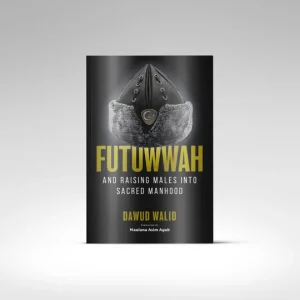
Futuwwah and Raising Males into Sacred Manhood
•Publisher: Imam Ghazali Publishing
•ISBN: 978-1-952306-38-9
•Pages: 180
•Binding: Paperback
Futuwwah and Raising Males into Sacred Manhood concisely discusses the principles within futuwwah, or spiritual chivalry, that young men should strive to embody and should inculcate into our communities. While the virtues discusses in this text are not all exclusively related to young males becoming men, this book is tailored towards males, and the specific issues faced by males as they strive to grow into the path of manhood. Just as young women need their own spaces to learn from women how to become honorable sisters, young men require their own special places to instill in them the virtues of upright brothers. The Islamic tradition calls for a revival of organized training relating to spiritual chivalry and sacred manhood - this is the task of the hour. There are beautiful and majestic qualities embodied by the Prophet s that he passed down to his family members and pious Companions. Those upright men were methodically raised up: they undertook rites of passage, and manly responsibilities which were placed upon them with expectations that they would be executed with excellence. This book begins by establishing the linguistic and operational definitions of the Arabic word futuwwah, translated here as "spiritual chivalry." The text then discusses the essential virtues for developing healthy manhood, in a specific order of their priority in teaching. The Qur'anic verses, Prophetic narrations, and sayings of pious Companions and scholars on the subject of futuwwah are related with sound meaning, accompanied by meticulous citations in footnotes and endnotes..
•ISBN: 978-1-952306-38-9
•Pages: 180
•Binding: Paperback
Futuwwah and Raising Males into Sacred Manhood concisely discusses the principles within futuwwah, or spiritual chivalry, that young men should strive to embody and should inculcate into our communities. While the virtues discusses in this text are not all exclusively related to young males becoming men, this book is tailored towards males, and the specific issues faced by males as they strive to grow into the path of manhood. Just as young women need their own spaces to learn from women how to become honorable sisters, young men require their own special places to instill in them the virtues of upright brothers. The Islamic tradition calls for a revival of organized training relating to spiritual chivalry and sacred manhood - this is the task of the hour. There are beautiful and majestic qualities embodied by the Prophet s that he passed down to his family members and pious Companions. Those upright men were methodically raised up: they undertook rites of passage, and manly responsibilities which were placed upon them with expectations that they would be executed with excellence. This book begins by establishing the linguistic and operational definitions of the Arabic word futuwwah, translated here as "spiritual chivalry." The text then discusses the essential virtues for developing healthy manhood, in a specific order of their priority in teaching. The Qur'anic verses, Prophetic narrations, and sayings of pious Companions and scholars on the subject of futuwwah are related with sound meaning, accompanied by meticulous citations in footnotes and endnotes..

This work answers many of the questions often asked by seekers of inward
illumination.
What are the real implications of the doctrine of divine unity?
How can proper concentration be achieved during spiritual exercises? And
when should one avoid participating in Sufi gatherings?

Let's learn to scare away shaytan so you don't get distracted from doing what is right!
Shaytan is a sneak, who loves getting us into trouble. He follows us throughout our lives and never gives up. Muslims know him as the 'evil whisperer' and have special defences against him.
Inside this book you will find out what they are so you can scare shaytan. It also explains where Muslims believe he came from, and what he is made from, with a lovable and cheeky young boy.

In this book, the reader is taken through the journey of life of this extraordinary woman. Stories of her sublime virtues, exceptional upbringing, Prophetic nurturing and inspirational family values are narrated.
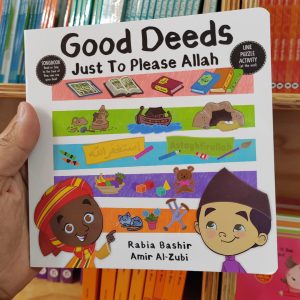
•Publisher: Kube Publishing
•ISBN: 9781999743215
•Pages:
•Binding: Hardcover
Good Deeds: Just To Please Allah is a colourful & vibrant board- It encourages mini Muslims to do five things to please Allah: read Qur’an, learn about the prophets, repent & improve, give thanks and do good deeds.
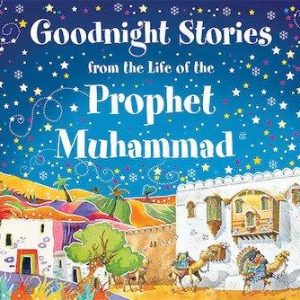
•Publisher: Goodword Books
•ISBN: 9788178985336
•Pages: 132
•Binding: Hardcover
Goodnight Stories from the Life of the Prophet Muhammad is the answer to every child's longing to hear a good bedtime story. It contains a careful selection of twenty three magnificent tales from the life of the Prophet retold in age-appropriate language. A simple text and fabulous colour illustrations, which bring the narratives vividly to life, make the message of the Prophet more meaningful for children. The book offers a special dimension to these wonderful goodnight stories, and acts as a foundation on which to build a growing knowledge of Islam.

Goodnight Stories from the Lives of Sahabah is the answer to every child's longing to hear a good bedtime story. It contains a careful selection of eighteen magnificent tales from the lives of the Companions of the Prophet Muhammad retold in age-appropriate language. A simple text and fabulous colour illustrations, which bring the narratives vividly to life, make the message of the Prophet and his Companions more meaningful for children. The book offers a special dimension to these wonderful goodnight stories, and acts as a foundation on which to build a growing knowledge of Islam.

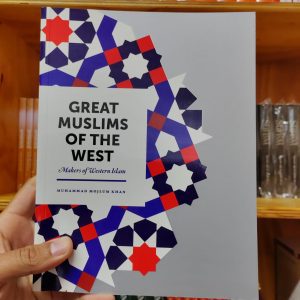
Great Muslims of the West – Muhammad Mojlum Khan
•Publisher: Kube Publishing
•ISBN: 9781847741127
•Pages: 500
•Binding: Softcover
Muslims have lived in the “West” for hundreds of years, yet the lives of all but a few are little known.
In this illuminating work, Muhammad Mojlum Khan sets out to change this by revealing the lives and impact of over fifty significant Muslims, from the founder of Muslim Spain in the eighth century to Muhammad Ali today.
This extraordinary book features biographies on the enslaved African Prince Ayuba Sulaiman Diallo, who was put to work in the tobacco fields of Maryland; Alexander Russell Webb, the voice of Muslims in Victorian America; and W.D. Muhammad, Elijah Muhammad’s son, who converted the Nation of Islam’s followers to an authentic version of Islam.
Muhammad Mojlum Khan was born in 1973 in Habigong, Bangladesh, and was brought up and educated in England. He is a literary critic, prolific writer, and a researcher in Islamic thought and history. He has published over 100 essays and articles on Islam, comparative religion, contemporary thought, and current affairs, and has been a regular contributor to The Muslim News. He has published two major works: The Muslim 100 and The Muslim Heritage of Bengal.
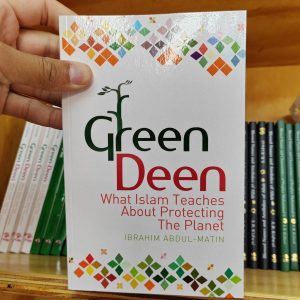
•Publisher: Kube Publishing
•ISBN: 9781847740403
•Pages: 236
•Binding: Softcover
Muslims are compelled by their religion to praise their Creator, pray, fast and give charity. But what is not widely known is that there are deep and long-standing connections between Islamic teachings and environmentalism.
In this ground breaking book, Ibrahim Abdul-Matin draws on research, scripture and interviews with Muslims to trace Islam's profound dedication to humankind's collective role as stewards of the Earth. Abdul-Matin points out that the Prophet Muhammad declared that the Earth is a mosque. 'Deen' means 'way' in Arabic. Abdul-Matin offers dozens of examples of how Muslims can follow, and already are following, a Green Deen in four areas: waste, watts (energy), water and food. At last, people of all beliefs can appreciate the gifts and contributions that Islam and Muslims bring to the environmental movement.

•Publisher: Sakina Publishing
•ISBN: 9780956614629
•Pages: 335
•Binding: Softcover
This book is beneficial for seekers on the spiritual path.
It begins with an introduction to the Bani Alawi Tariqa, outlining the history, the development, principles and key figures.
It gives the reader an insight into the ethics and the doctrine of the path, with pearls of wisdom from the classical masters from the Sada Ba Alawi, such as Imam Al-Haddad who says:
‘The Bani Alawi Tariqa is the most upright and balanced Tariqa. Their conduct is the best and most exemplary, they are upon the most admirable way, broad and vast, with clear legislation.’
There is nothing better for a person in this era, who desires the path, to correct his understanding of the principles of tawhid, perform the obligations, refrain from the forbidden, perform the sunna in accordance with the Quran and Sunnah without disregarding them. And if these things flourish within him he has received a lot of good.’
‘If a seeker masters the path of the People of the Right, he ascends at the hands of his masha’ikh to the path of the foremost.’

Author: Jonathan A.C. Brown
Format: Paperback
Pages: 368
Publisher: Oneworld Publications
Contrary to popular opinion, the bulk of Islamic law does not come from the Quran but from hadith, first-hand reports of the Prophet Muhammad’s words and deeds, passed from generation to generation. However, with varying accounts often only committed to paper a century after the death of Muhammad, Islamic scholars, past and present, have been faced with complex questions of historical authenticity.
In this wide-ranging introduction, Jonathan A. C. Brown explores the collection and criticism of hadith, and the controversy surrounding its role in modern Islam. This edition, revised and updated with additional case studies and attention to the very latest scholarship, also features a new chapter on how hadiths have been used politically, both historically and in the Arab Spring and its aftermath. Informative and accessible, it is perfectly suited to students, scholars and general readers interested in this critical element of Islam.

• Publisher The Islamic Texts Society
• ISBN 978-0946621385
•Pages 192
• Binding Softcover
The hadith, the sayings attributed to the Prophet Muhammad, form a sacred literature which for the Muslims ranks second in importance only to the Qur'an itself. As a source of law, ethics and doctrine, the vast corpus of hadith continue to exercise decisive influence. Islamic scholarship has hence devoted immense efforts to gathering and classifying the hadith, and ensuring their authenticity. This book is the only introduction in English which presents all the aspects of the subject. It explains the origin of the literature, the evolution of the isnad system, the troubled relationship between scholars and the state, the problem of falsification, and the gradual development of a systematic approach to the material. This edition is a fully revised and updated version of the original, which was first published in 1961 to considerable scholarly acclaim. Muhammad Zubayr Siddiqi was Professor of Islamic Culture in the University of Calcutta.
• ISBN 978-0946621385
•Pages 192
• Binding Softcover
The hadith, the sayings attributed to the Prophet Muhammad, form a sacred literature which for the Muslims ranks second in importance only to the Qur'an itself. As a source of law, ethics and doctrine, the vast corpus of hadith continue to exercise decisive influence. Islamic scholarship has hence devoted immense efforts to gathering and classifying the hadith, and ensuring their authenticity. This book is the only introduction in English which presents all the aspects of the subject. It explains the origin of the literature, the evolution of the isnad system, the troubled relationship between scholars and the state, the problem of falsification, and the gradual development of a systematic approach to the material. This edition is a fully revised and updated version of the original, which was first published in 1961 to considerable scholarly acclaim. Muhammad Zubayr Siddiqi was Professor of Islamic Culture in the University of Calcutta.

•Publisher: Imam Ghazali Publishing
•ISBN: 9,781,088,188,842
•Pages: 180
•Binding: Paperback
Hafiz ‘Abd al-Ghani ibn ‘Abd al-Wahid al-Maqdisi's Reports on the Dajjal (Akhbar al-Dajjal) is a collection of Prophetic narrations that mention the Dajjal, known in English as the Antichrist. The subject of the Dajjal, the Antichrist, is one which generates much speculation, which in turn often leads to confusion. It is hoped that publication of this collection will help to clarify the most important issues related to this matter, and help us to draw lessons that are useful and applicable to our own lives. In turn, this clearer understanding may help us to warn those who are close to us about the great trial of the Dajjal and its dangers, and to take steps to protect our own faith and that of our loved ones. The majority of this text consists of the hadith themselves, which are given with their full chain of narrators. Citations to the source of each hadith in the major collections are included in the footnotes; where a narration is present in more than one of the major collections, all citations are included. The text also includes light commentary from both the author and translator when appropriate, regarding the hadith itself, its narrators, the strength of its chain, and other points.
•ISBN: 9,781,088,188,842
•Pages: 180
•Binding: Paperback
Hafiz ‘Abd al-Ghani ibn ‘Abd al-Wahid al-Maqdisi's Reports on the Dajjal (Akhbar al-Dajjal) is a collection of Prophetic narrations that mention the Dajjal, known in English as the Antichrist. The subject of the Dajjal, the Antichrist, is one which generates much speculation, which in turn often leads to confusion. It is hoped that publication of this collection will help to clarify the most important issues related to this matter, and help us to draw lessons that are useful and applicable to our own lives. In turn, this clearer understanding may help us to warn those who are close to us about the great trial of the Dajjal and its dangers, and to take steps to protect our own faith and that of our loved ones. The majority of this text consists of the hadith themselves, which are given with their full chain of narrators. Citations to the source of each hadith in the major collections are included in the footnotes; where a narration is present in more than one of the major collections, all citations are included. The text also includes light commentary from both the author and translator when appropriate, regarding the hadith itself, its narrators, the strength of its chain, and other points.